
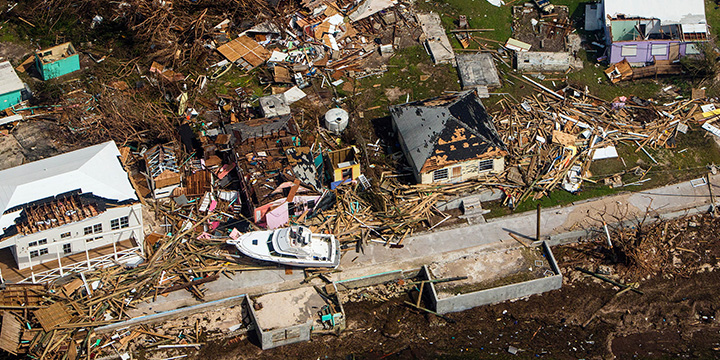
The Disaster Risk Management Authority (DRM Authority) represents an exciting shift in the Bahamas government's approach to disaster planning and response - a shift precipitated by the monster hurricane Dorian in 2019.
Dorian was a wake-up call. It brought unprecedented devastation to the Bahamian islands of Abaco and Grand Bahama and revealed that climate change had made the country’s seasonal enemy significantly stronger. The government realised that a stronger enemy required a stronger defence. This realisation led legislators to develop and pass the Disaster Risk Management Act in December 2022.
Through this forward-thinking and innovative new legislation, the government merged the long-standing National Emergency Management Agency (NEMA) and the comparatively new Disaster Reconstruction Authority (DRA) to create the DRM Authority.
Whereas NEMA was responsible for immediate hurricane preparedness activities and the DRA for long-term reconstruction in a storm’s aftermath, the DRM Authority is responsible for implementing the complete cycle of disaster management actions: mitigation, preparation, response, and recovery.
On April 15th, 2024, after 18 months of careful planning and foundation laying by the executive leadership of the DRA and NEMA, the DRM Authority Act came into force. Shortly after that, its directors, board chair, and managing director were appointed, and the organisation began its official operations on July 1st, 2024.
The Authority’s structure as a quasi-government organisation creates an agile, data-driven organisation that, at its core, is focused on safeguarding lives, fostering a culture of preparedness, and ending the financial hardship that the cycle of recovery from successive disaster events has created for both the government and people of the Bahamas.
Through the work and mandate of the DRM Authority, our country can now focus on prevention rather than recovery and on building resilience rather than merely reconstructing what was lost.
Following Hurricane Dorian, the disaster management framework in The Bahamas underwent significant changes. The Government of The Bahamas established the Disaster Reconstruction Authority (DRA) and the Ministry of Disaster Preparedness, Management, and Reconstruction in response to this catastrophic event. In 2022, the passage of the Disaster Risk Management Act prompted an expansion and reorganisation of the nation’s disaster risk management program, leading to the establishment of the DRM Authority in 2024 through the merger of the National Emergency Management Agency and the DRA, repealing their respective legislation to prioritise the mandates of the DRM Act (2022).
The project will:
- Develop a strategic plan for the DRM Authority that supports a culture of innovation, equal opportunity, operational efficiency, and strong partnerships with stakeholders;
- Prepare a continuity of operations plan for the DRM Authority and enhance capacity and capabilities of the DRM Authority and public bodies for continuity of operations planning;
- Strengthen the ability of DRM Authority to design targeted interventions for vulnerable households through a gender-responsive and socially-inclusive national assessment of individual and household disaster preparedness and vulnerability; and
- Improve the effectiveness of The Bahamas’ evacuation mechanisms through the preparation of a mass evacuation plan that decentralises planning and procedures and facilitates the safe, timely, and efficient relocation of at-risk populations during disaster emergencies.
The costliest hurricane in the Bahamas’ history, with sustained winds of 185 mph. It made landfall as a Category 5 hurricane.
One of four Category 5 hurricanes to hit the Bahamas, with sustained winds of 160 mph. It caused 18 deaths. At nearby Hope Town, a pressure of 921 mbar (27.2 inHg) was recorded, and 83 homes were destroyed while another 63 were severely damaged. At Green Turtle Cay, a large storm surge inundated the entire island, flooding homes, churches, and businesses. At Green Turtle Cay alone, six people died while another 25 were injured. Multiple vessels to the north of Abaco Island also reported low pressure, one even reporting 936 mbar (27.6 inHg) while another vessel recorded 934 mbar (27.6 inHg).
- One of four Category 5 hurricanes to hit the Bahamas. Hurricane Andrew was a compact, but very powerful and devastating tropical cyclone that struck the Bahamas, Florida, and Louisiana in August 1992. It was the most destructive hurricane to ever hit Florida in terms of structures damaged or destroyed, and remained the costliest in financial terms until Hurricane Irma surpassed it 25 years later. Andrew was also the strongest landfalling hurricane in the United States in decades and the costliest hurricane to strike anywhere in the country, until it was surpassed by Katrina in 2005.
Killed over 330 Bahamians. The 1899 San Ciriaco Hurricane was a Category 4 hurricane that hit Puerto Rico, the Bahamas, North Carolina, and other areas. It was the costliest and deadliest tropical cyclone in Puerto Rico’s history at the time.
One of four Category 5 hurricanes to hit the Bahamas, with sustained winds of 160 mph. It caused 18 deaths. At nearby Hope Town, a pressure of 921 mbar (27.2 inHg) was recorded, and 83 homes were destroyed while another 63 were severely damaged. At Green Turtle Cay, a large storm surge inundated the entire island, flooding homes, churches, and businesses. At Green Turtle Cay alone, six people died while another 25 were injured. Multiple vessels to the north of Abaco Island also reported low pressure, one even reporting 936 mbar (27.6 inHg) while another vessel recorded 934 mbar (27.6 inHg).